How to Ask for a Deposit From Clients (Scripts Included)
How to ask for a deposit without awkwardness: when to raise it, the exact words for WhatsApp, email and calls, replies to pushback, and how to collect it.



How to ask for a deposit: state it as part of how you work, not as a favour. Put the amount, what it secures and the deadline in the quote, repeat it in one short message when the client says yes, send a payment link straight away, and confirm in writing once it’s paid.
Key takeaways
- Raise the deposit before the client says yes, in the quote or price list, so it’s never a surprise.
- Say what the deposit secures (the date, the materials, your time), not what you’re afraid of.
- Send the payment link in the same message as the request. Every extra step loses some clients.
- Write down what happens if they cancel. In some countries a business can only keep what covers its real loss.
- Use the same words every time. A script removes the awkwardness.
Why asking for a deposit feels awkward (and why it shouldn’t)
Most owners hesitate because a deposit feels like a sign of distrust. Clients rarely see it that way. A deposit tells them you’re booked up, organised and serious about their date. Doctors, airlines, event venues and wedding vendors all take money upfront, and nobody thinks less of them.
What clients do dislike is surprise. A deposit that appears for the first time on the invoice, after they’ve agreed a price, feels like a new condition. The fix is timing and wording, not courage.
This page is about the asking. For how much to charge and which structure to use, see our guide to how much deposit to charge clients, or use the deposit calculator.
What you need before you ask
- A deposit rule: the percentage or fixed amount, and which jobs it applies to.
- What it secures: the date, the slot, materials you’ll buy, or time you’ll block.
- Your cancellation terms: what happens to the deposit if the client cancels, reschedules or doesn’t show. Our no-show policy template helps with this.
- A way to get paid in one tap: a payment link, a booking page that takes the deposit, or your bank details.
- Written terms: a line in your quote or a short agreement. The service agreement template has a payment section you can reuse.
How to ask for a deposit, step by step
Step 1: Put the deposit in your price list and quote
Every quote should show the total, the deposit, the balance and when each is due. Write it as part of your payment terms, for example: “30% deposit to confirm your date. Balance due 7 days before the event.”
When the deposit is printed on the quote, the client agrees to it when they agree to the price. You don’t have to ask a second time; you only remind.
Step 2: Say what the deposit secures
Link the deposit to something the client wants. “To hold Saturday 14 March for you” lands better than “to protect us against cancellations”. Both are true. Only one is about the client.
Step 3: Ask the moment they say yes
The best time to ask is right after the client agrees, while they’re keen. Waiting a few days lets doubt creep in, and the date you were holding may go to someone else.
Step 4: Send the payment link in the same message
Put the amount, the deadline and the link in one message. If the client has to ask “how do I pay?”, you’ve added a step and a delay. If you take bank transfers, include the account name, number and a reference.
Step 5: Set a deadline and say what happens after it
“I can hold the date until Friday 6pm” is clear and fair. It also gives you a reason to follow up without sounding pushy.
Step 6: Confirm in writing when it’s paid
Send a receipt and a short confirmation: date secured, amount received, balance and due date. This is the message the client will look for if there’s a dispute later.
Step 7: Follow up once, then release the slot
If the deadline passes, send one friendly reminder. If there’s still no payment, tell the client the date is released. Most will either pay or tell you honestly that they’ve changed their mind.
Deposit request scripts you can copy
Change the words in square brackets. Keep the structure: thanks, what it secures, amount, link, deadline.
WhatsApp message after the client says yes
Hi [Name], great, I’m glad we’re going ahead! To lock in [date] for you, I take a [30%] deposit of [amount]. You can pay here: [link]. I’ll hold the date until [day, time]. The balance of [amount] is due [when]. Any questions, just ask.
Deposit request email
Subject: Securing your booking for [date]
Hi [Name],
Thanks for confirming. I’m looking forward to [the project].
To secure [date] and order [materials], I take a deposit of [amount] ([percentage] of the total). You can pay by card or bank transfer here: [link].
I’ll hold your date until [day, time]. Once the deposit is in, I’ll send a receipt and the next steps. The balance of [amount] is due on [date].
If you need to change the date later, [your terms, for example: the deposit moves with you once if you give 7 days’ notice].
Thanks, [Your name]
On the phone
“Brilliant. The way I work is a [30%] deposit to hold the date, and the rest [when]. I’ll send you a link on WhatsApp now, and once that’s paid the date is yours.”
Then send the link before you hang up, while they still have the phone in their hand.
Reminder when the deadline is close
Hi [Name], just a quick reminder that I’m holding [date] for you until [time] today. Here’s the payment link again: [link]. If your plans have changed, no problem, just let me know so I can free up the date.
When the client pushes back
| They say | You say |
|---|---|
| “Can I pay everything on the day?” | “I take a deposit from everyone so I can turn other bookings away for your date. Once it’s paid, the date is fully yours.” |
| “Other people don’t charge a deposit.” | “I understand. The deposit is how I make sure I can give your job my full attention on the day, without double-booking.” |
| “Can I pay the deposit next week?” | “I can hold the date until [day]. After that I’ll need to offer it to the next person on my list.” |
| “What if I need to cancel?” | “If you cancel more than [7] days before, [your terms]. It’s all in the quote I sent.” |
| “Can you reduce it?” | “I can split it: [half] now to hold the date and [half] by [date].” |
Only offer the split if you’re happy with it. One concession is fine; reopening your terms every time isn’t.
Worked example: a photographer in Lagos and a cleaner in London
These figures are illustrative.
| Lagos wedding photographer | London end-of-tenancy cleaner | |
|---|---|---|
| Total price | ₦850,000 | £240 |
| Deposit | 30% = ₦255,000 | 25% = £60 |
| Balance | ₦595,000, due 7 days before the wedding | £180, due on completion |
| What the deposit secures | The wedding date and a second shooter | The slot and the van |
| How it’s paid | Paystack link by card, bank transfer or USSD | Card payment link |
The photographer turns down other enquiries for that Saturday once the deposit is in, so ₦255,000 is the price of that commitment. The cleaner’s £60 covers the loss if the client cancels the day before and the slot can’t be refilled.
In both cases the script is the same: thanks, what it secures, amount, link, deadline.
What the law says about keeping a deposit
Rules depend on where you and your client are, so treat this as general information, not legal advice.
In the UK, Citizens Advice explains that services arranged online or by phone usually come with a 14-day cooling-off period (checked on 1 October 2026), during which the customer can cancel and get their money back. If the customer asked you to start within those 14 days, you can keep enough to cover the work already done. Outside the cooling-off period, a business should only keep enough to cover its actual loss.
Elsewhere, the practical rule is the same: write your terms down, tell the client before they pay, and keep only what’s fair. A deposit you can explain is a deposit you can keep.
Common mistakes when asking for a deposit
- Asking after the price is agreed. Put the deposit in the quote so it’s part of the deal.
- Apologising. “Sorry, I hate to ask, but…” tells the client it’s negotiable.
- No link. “Let me know when you’ve paid” invites delay. Send the link.
- No deadline. Without one, you’re holding the date for free.
- Vague cancellation terms. “Non-refundable” with no detail invites a row. Say what happens and when.
- Different rules for different clients. Inconsistency is what makes it awkward. Use the same rule and script for everyone.
How to take deposits in startbuddi
startbuddi takes deposits two ways: when a client books, and with a payment link you can drop into any chat. Clients pay by card through Stripe, or by card, bank transfer, USSD or mobile money through Paystack, where Paystack offers those channels (checked on 1 October 2026).
- Take the deposit at booking. In Bookings, open a service, set the price and turn on Require payment to book, then choose to take a deposit rather than the full amount. The client sees “Deposit due now” at checkout, and the slot is held for 30 minutes while they pay. Paying confirms the booking deposit and the booking.
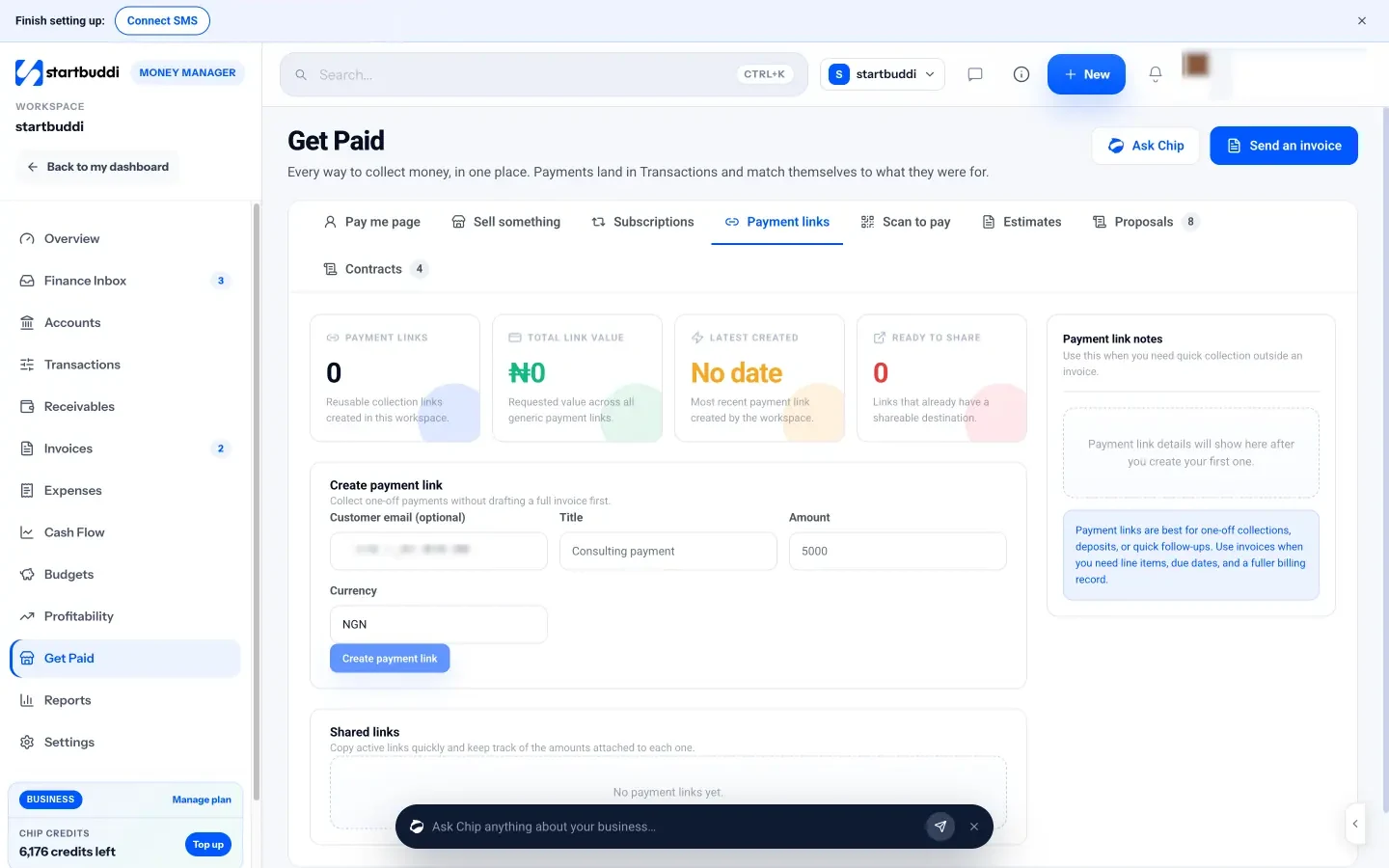
- Send a payment link for anything else. In Money Manager, open Get Paid, then Payment links, and create a link with a title such as “Deposit: wedding, 14 March” and the amount. Copy it into WhatsApp or Instagram, or send it by email. The link shows as paid when the client pays.
- Put the deposit in the estimate. When you create an estimate, add your deposit terms in the notes, for example “30% deposit to begin”. When the client accepts, convert it to an invoice with the same line items.
- Record transfers that arrive outside startbuddi. On the invoice, use Record payment for a bank transfer or cash. Partial payments are allowed, so the invoice shows Partially paid until the balance comes in.
A free plan is available. See pricing for what each plan includes, or read how freelancers use payment links. If you’re still setting your rates, the pricing strategy guide covers deposits alongside packages and discounts.
Make the deposit part of how you work
Write your deposit rule once, save the scripts, and send a link every time. Start free with startbuddi, no card needed, and let your booking page or payment link do the asking for you.
Frequently asked questions
How do you politely ask for a deposit?
Ask for a deposit politely by tying it to what the client gets: "To hold your date, I take a 30% deposit." Thank them, give the amount, send a payment link in the same message and set a clear deadline. Don't apologise, because an apology makes the deposit sound optional.
When should I ask a client for a deposit?
Ask for a deposit as soon as the client agrees to go ahead, and show it in your quote before that. The deposit should never appear for the first time on an invoice. Asking straight away also stops you holding a date for someone who isn't committed.
What should a deposit request message include?
A deposit request message should include a thank-you, what the deposit secures, the amount, a payment link or bank details, and a deadline. It helps to add the balance and its due date. Keep it to four or five sentences so it reads well on a phone.
Can I keep a deposit if the client cancels?
It depends on your written terms and the law where you work. In the UK, Citizens Advice says a business should generally keep only what covers its actual loss, and customers who book services online or by phone usually have a 14-day cooling-off period. Write your cancellation terms down and share them before the client pays.
What if a client refuses to pay a deposit?
If a client refuses to pay a deposit, explain once what it secures and offer a split if you're comfortable with one. If they still refuse, you can decline the booking or ask for full payment closer to the date. A client who won't commit a small amount now may still be shopping around.
Olabimpe Salami is the email and outreach specialist at startbuddi. Olabimpe writes about the messages that bring customers in and back: email, WhatsApp and SMS campaigns, follow-ups, and turning enquiries into paying clients.
Runs email and outreach at startbuddi