Employer Branding and Talent Acquisition: A Practical Guide for Small Business Owners
Employer branding and talent acquisition for small businesses: what an employer brand is, how it helps you hire, a one-page template and a 30-day plan.



Employer branding and talent acquisition work together: your employer brand is what people believe it’s like to work for you, and talent acquisition is how you find and hire them. A clear, honest employer brand brings better-matched applicants, more referrals and fewer early leavers. For a small business, it starts with how you treat your current team and candidates.
Key takeaways
- Your employer brand exists whether you manage it or not. It’s built from what staff say, how candidates are treated and what people find when they look you up.
- For small teams, the strongest employer brand assets are free: honest job adverts, a fast and respectful hiring process, and employees who’d recommend you.
- An employee value proposition (what you offer, and what you expect in return) is the core of the brand. Write it on one page.
- Don’t promise what the job isn’t. A brand that oversells leads to quick resignations.
- Measure it with simple numbers: applicants per role, offer acceptance, referrals and whether new hires stay.
What is employer branding?
The CIPD’s employer brand factsheet (checked on 1 October 2026) quotes a widely used definition: the employer brand is “the image of an employer that has been perceived by current and potential employees”. It sits alongside the employee value proposition (EVP), which the CIPD describes as what an organisation “stands for, requires and offers as an employer”.
In plain words: the employer brand is your reputation as a place to work, and the EVP is the honest deal behind it. A consumer brand tells customers why to buy from you. An employer brand tells good people why to work for you, and why they might not.
Why employer branding and talent acquisition go together
Talent acquisition is the ongoing work of planning, finding, hiring and keeping the people your business needs. If you’re not sure how that differs from filling a single vacancy, read our comparison of talent acquisition vs recruitment. Employer branding feeds every stage of it:
| Talent acquisition stage | What the employer brand changes |
|---|---|
| Attracting candidates | Whether the right people apply, and whether the wrong ones rule themselves out |
| Referrals | Whether your staff recommend you to friends |
| Interviews | Whether strong candidates stay in the process or drop out |
| Offers | Whether candidates accept, and how hard they negotiate |
| Onboarding and retention | Whether the job matches what was promised, so people stay |
Large companies take this seriously. The CIPD factsheet reports, from its 2024 resourcing and talent planning report, that 81% of respondents had taken action to improve their employer brand in the previous year. Small businesses compete for the same people, often without the salary budget, so what candidates hear about you matters even more.
How employer branding works in a small business
You don’t need a careers site or a recruitment marketing budget. In a team of 5 to 20 people, the employer brand is built in five places.
1. What your team says
Candidates ask friends, check LinkedIn and read reviews. If your developer tells people you pay late and change priorities daily, no advert will fix that. The most reliable employer brand work is being a good place to work and asking the team how you’re doing.
2. Your job adverts
The advert is often the first deliberate message a candidate gets from you. Say what the job involves day to day, what success looks like, the pay range and the working pattern. If you advertise online, Google’s job posting guidelines (checked on 1 October 2026) list salary as a recommended detail for jobs shown in Google’s job search, alongside the job title, description and location. Clear pay saves everyone time.
3. How you treat candidates
Reply to every applicant. Give a timeline and keep to it. Pay for work samples that take more than an hour. Candidates who don’t get the job still talk about how you treated them, and some will apply again or refer someone.
4. Your onboarding
The first weeks prove whether the brand was true. A planned first day, a named person to ask questions and a clear 90-day goal tell a new hire they made the right choice. See our definition of employee onboarding.
5. Your public presence
Your website, social posts and founder’s profile show what you care about. A short “working with us” page or a post about how the team works is enough at first.
Employer brand for talent acquisition: a one-page EVP template
Copy this and fill it in. Keep each answer to one or two lines, and check it with your team before you use it in an advert.
| Section | Question to answer | Example: a 9-person design studio in Accra |
|---|---|---|
| Who we are | What do we do and for whom? | We design brands and websites for growing West African businesses. |
| The work | What will someone actually spend their days on? | Real client projects from week two, with a senior designer reviewing your work. |
| Pay and benefits | What do we pay and offer? | Salary in the advertised range, paid in GH₵, plus a yearly training budget. |
| How we work | Hours, location, flexibility | In the studio Tuesday to Thursday, remote Monday and Friday. |
| Growth | How do people grow here? | Two people promoted from junior to mid-level in the last two years. |
| What we expect | What do we ask in return? | Clients come first in deadline weeks; we work late a few times a year. |
| Why people leave | What should a candidate know before joining? | It’s a small team, so roles are broad and processes are still being built. |
The last two rows are the ones most businesses skip, and they’re the most useful. Telling candidates the hard parts up front filters out people who’d leave in three months.
Examples of employer branding in talent acquisition
These are illustrative situations, not real companies.
- A cleaning company in Manchester struggles to keep staff. It starts putting the hourly rate, guaranteed hours and the fact that travel time between jobs is paid at the top of every advert. Applicants drop slightly, but the people who apply stay longer, because the deal is clear.
- An IT support firm in Lagos has no budget for agency fees. The founder asks each engineer what they’d tell a friend about the job, and uses their words in the next advert. Two of the next three hires come from staff referrals.
- A Toronto bookkeeping practice loses candidates after interviews. It turns out the process takes five weeks. It cuts the process to two weeks with one structured interview and a short paid task, and offer acceptance improves.
How to build your employer brand in 30 days
For the wider hiring habits around this, see our list of talent acquisition best practices and our guide to building your first team.
Mistakes to avoid with employer branding in talent acquisition
- Overselling. “Fast-growing, fun, family culture” means nothing and sets expectations you can’t meet.
- Copying big company perks. Free lunches aren’t your edge. Direct access to the founder, real responsibility and flexibility might be.
- Ignoring rejected candidates. Silence after an interview spreads further than a good advert.
- Unfair adverts. Words that signal a preferred age, gender or background can break the law in many countries and narrow your pool.
- Treating it as a one-off campaign. The employer brand is what your team experiences every week. Check in with them regularly, not just when you’re hiring.
Where startbuddi fits
startbuddi doesn’t include an applicant tracking system or careers pages, so it won’t post jobs or collect applications. It helps with the parts of employer branding that happen inside the business:
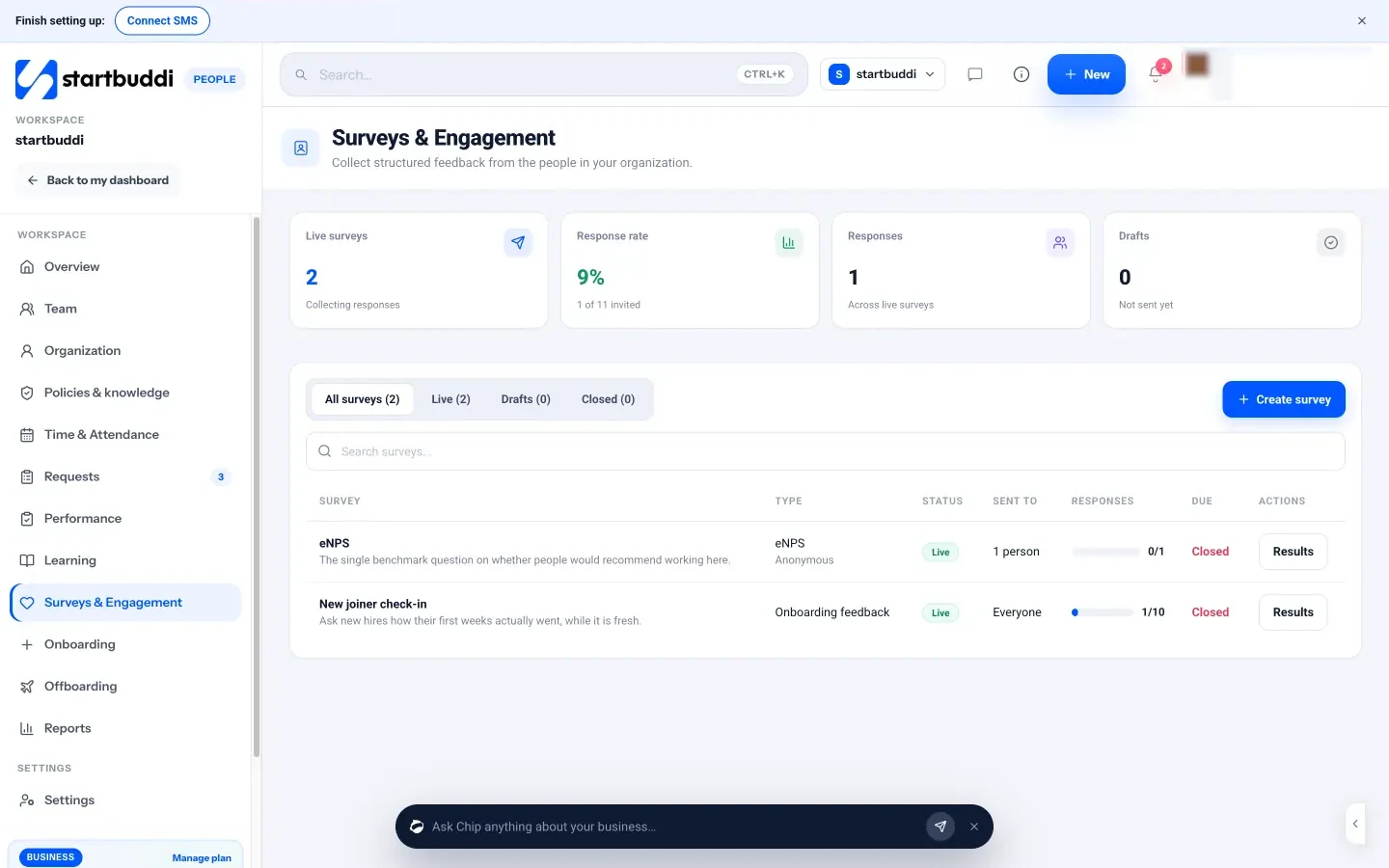
- Ask your team. In People, Surveys include pulse checks, eNPS, a new joiner check-in and an exit interview template, and responses are anonymous by default.
- Write it down. Keep your ways of working and policies in the handbook and knowledge base, and see who has acknowledged each policy. Our free employee handbook template is a starting point.
- Onboard well. Start an onboarding checklist for each new hire, so the first weeks match what you promised.
- Draft with Chip. In a normal chat, ask Chip to draft your EVP or a job advert from your notes, then edit it in your own words.
A free plan is available; inviting team members needs a paid plan with seats. See pricing or how startbuddi works for startups.
Build a team people want to join
Fill in the one-page EVP this week, then ask your team how you’re doing. Start free with startbuddi to run surveys, keep your handbook and onboard new hires in one place.
Frequently asked questions
What is the role of employer branding in talent acquisition?
Employer branding shapes who applies, who accepts your offer and who stays. A clear, honest brand attracts people who fit the job and puts off people who don't. That makes every stage of talent acquisition cheaper and faster.
How can a small business build an employer brand with no budget?
Start with your current team: ask what they'd tell a friend about working for you, and fix what they raise. Then write honest job adverts with pay ranges, reply to every candidate and plan onboarding. None of these cost money, only time.
What is an employee value proposition?
An employee value proposition is what an employer offers its people and what it expects in return: pay, the work, growth, flexibility and culture. It's the substance behind the employer brand. Writing it down helps you describe the job honestly.
How do you measure employer branding for talent acquisition?
Track applicants per role, the share of applicants who meet your must-haves, offer acceptance rate, referrals and how many new hires are still with you at 90 days and a year. Add an employee survey score such as eNPS to see how the team feels.
Is employer branding the same as recruitment marketing?
No. Recruitment marketing is promoting specific jobs to candidates. Employer branding is the wider reputation those campaigns rely on. Good recruitment marketing can't make up for a poor experience of working for you.
Should I include the salary in job adverts?
Usually, yes. A clear pay range saves time on both sides, attracts people who can accept the offer and is increasingly expected or required in some places. Check the rules where you're hiring.
Tiwalade Joanna Okedara-Kalu is the founder, CEO and CTO of startbuddi, the business system that brings clients, bookings, invoices, projects, marketing and the Chip AI assistant into one place. Tiwalade builds software around how service businesses really work day to day, and writes about client management, getting paid on time and why small businesses outgrow the tools they start with.
Founded startbuddi and leads its product and engineering